Cognitive Dissonance, Fear, and Creative Freedom

The countless stories of failed album creation often reveal the undying belief of an artist who goes down dark paths of unrealized potential and bad decisions. The effects can be heartbreaking in the moment but, sometimes, inspiring years later. This revisionist history of popular music is easily found in the archives of Rolling Stone magazine, but you can search your own life story to find those horrendous moments of indecision or poorly executed decisions. However, from the broken pieces of your experience, did you just create Yankee Hotel Foxtrot or Physical Graffiti? You know, those terrible albums that couldn’t possibly hold any value for a single person outside of the narcissistic artist who dared waste valuable studio time.

There are paths we all carve to find purpose, but it’s littered with so many uncertainties that living in the moment is nearly impossible for those trying to balance creativity with practical decisions. Add in a dose of mental illness and you’ve created a cocktail of fear-based decisions that will eventually come back to bite you. There are very few people willing to unconditionally support someone who spends far too much time figuring out their issues, rather than implementing a solid plan to thrive despite them. When you’re your own worst enemy, the people around you can see it. Unfortunately, they’re also the first people to suffer the ill effects of your poor decisions.

The discourse around popular music and life choices is so much of the same horse poo–tales of debauchery and loose morals, leading to an absence of clarity and beauty. However, the reality for most is a disconnection of emotional understanding in pursuit of manageable victories. The recording studio may sound glamorous, but replace the mixing board with your own brain, and you begin to understand how each sound level adjustment and edit can lead to a mess of an album and a mess of your life.

Entering the studio, like approaching any new relationship, job, or foreign experience, begins for so many with a vision. A sonic architect’s drawing from the cerebral world, plotted with possibilities, expectations, and desires. When I first heard Kate Bush, I allowed some moment of fixation with her voice, but quickly found myself connected to her artistic presence. For me, it was during a time of sexual insecurity and being surrounded by mirrors that were throwing back images of someone struggling with body dysmorphia and self-hate. I was afraid to express myself creatively because any rejection at that point would be hammering a death nail in my emotional coffin.

However, Kate Bush displayed a confidence and strength unfamiliar to me. She was a fighter doing battle with fear and the weight of unrealistic expectations for someone so young. She danced her way through gorgeous patterns of audible color and brought forth to me a world disconnected from gender norms and mockery. What a wonderful moment it must have been for her to see “The Kick Inside” released with her powerful stamp firmly affixed ahead of record company executives and music marketing experts. When the album landed, Kate was 19 years old.

Live a life of fear and your decisions become your greatest failures. That’s not to say your values and beliefs are completely nullified, but those parts of you will often defer to your obsession with satisfying everyone. Ultimately, you’re producing track after track of betrayal to yourself, while alienating those who desire the same gorgeous layers of beauty they know you can create.

If your force is overwhelmed by those rejecting your vision, be prepared for the finished product. The lying pleasures of the masses can lead to false beliefs and failed opportunities to right the ship. If you continue this course, by the time your third album arrives, the songs don’t matter, the production is more about the temporary influences in your life, and  you’re listening to everyone except yourself. Oh, how different things could have been if you’d just rejected slick production for the rawness of honesty and simplicity. After all, it’s your vision. It’s your life.

Sendak and Patti Smith: The Lyrics and the Stories

Don’t put your faith in musicians. Specifically, don’t put your faith in rock stars. Why? They’re living between the bookends. It’s the place between birth and death all who read these words inhabit. It’s the place we fuck up and it’s the place in which we discover and rediscover. The lyric writer’s prose is intended to simplify, not to clarify. We don’t find answers in songs—we find a commonality to make us feel normal. That’s a purity you find in childhood. There’s an undisturbed quality to just being a kid, before the responsibilities invade and you start answering the questions you’ve carried for so long.

The first time I walked down Columbus Ave. in San Francisco, I was just within the first bookend. I was closer to birth than death and my senses were adolescent. It was raining and I was in love. Writers, musicians, and ghosts approached me. They saw I carried a book of hastily arranged questions, some from early childhood, but most compiled as I got lost in criticism, sexual desire, and lying. Conversations were had, and loss of faith was happening in the midst of supreme happiness. There’s nothing more engaging than exploring a city, armed with nothing more than questions. The most profound and the most mundane questions take you down alleys and into coffee shops. You don’t find answers, but you find plenty of conversations.

I engaged with the city for hours, never asking to feel well or saved. I moved from door to door, window to window, glass to glass, reaffirming my commitment to not find answers. I was gliding through the long shelf of books that made up my story. I dropped my bags each time at the end of Columbus Ave., away from the proper end of Little Italy. The Travel Lodge was right up against Tower Records, which was both exciting and heartbreaking. With money for little more than cigarettes, coffee, and wine, it was a teasing reminder of my expanding interest in music. I made my way down the street, stopping in to see the familiar and wanting desperately to find the unfamiliar. There were no answers to the questions I carried. If nothing else, I walked away from the city with more questions about the place between the bookends.

You won’t find the answers in those song lyrics, so you certainly won’t find your answers on someone else’s bookshelf. If you’re lucky, you’ll walk away with more questions, and the 2nd bookend won’t seem so frightening. Maurice Sendak and Bill Watterson presented their questions in a format often considered for and featuring children: animation. When you’re a child, you’re not required to find answers, but, over time, you sense it’s a reality you’ll soon have to face.

When a teenager explores song lyrics or music culture, adults often fear they’re finding answers not approved within their parenting plan. Those same parents may falsely assume that answers need to be found quickly, both for their children and themselves. And, if those answers aren’t found, they’ll never grow up. The answers aren’t the death of childhood but, sometimes, they’re the death of discovery. If they’re forced, they can make us unhappy—we lose faith in ourselves and we lose faith in those we assumed had the answers. Never put your faith in rock stars.

Instead, believe in the honesty of the writer and find purpose in your own story. Patti Smith helped me understand why questions never need to be answered. Sometimes you just need to accept that life is messy, but you’ll find your way. If your compass is broken, a musician’s tools can only do so much, but it’s still beautiful to watch them work.

Finding Ways to Land: Free Jazz

I’ve been lying to myself for a long time. For me, lying is often the easiest way to resolve an internal conflict, but the consequences are horrendous. Sure, for a short time, it frees me of the responsibility to face my problems. However, in the end, I feel like a coward and everyone around me suffers. That’s emotional dishonesty, and it’s the worst kind of lying for me.

When I discovered Ornette Coleman, jazz had only been a small talking point in my musical life–a cultural reference to understand the develop of music. From a listening perspective, I sought what was enjoyable and pleasant. Now, this was during the swing revival of the 90s, so bands like Squirrel Nut Zippers informed many of my choices. I’m half kidding, but you get the point. What initially brought me to Ornette was an essay that would change my life forever: Lester Bangs’ Free Jazz/Punk Rock, which I always refer to as Free Jazz is Punk Rock in conversation. I know it’s not correct, but it sounds way more aggressive. It’s an essay I’ll come back to another time because it deserves a more focused discussion. However, for now, it can be viewed as the motivation for me to explore. The main point of Bangs’ essay is to relate the bravery found in free jazz to New York’s No Wave bands. The purity and intensity found in both deliver an almost spiritual path to emotional honesty.

Backing up just a bit, there’s a back story in the development of jazz that sometimes gets overlooked from a cultural perspective–jazz as entertainment.  Which it was…for a very long time. For a moment, Dizzy Gillespie was utilized by the U.S. State Department to advance democracy around the world and to counter communist propaganda. It was thought that using a successful black man to promote American values was proof of a superior society. However, at the same time, the birth of the Civil Rights movement was approaching and black citizens were being denied basic human rights. Ornette Coleman rejected the presentation of jazz as purely entertainment. Within the very musical compositions, a world of emotion could be expressed. While certainly nothing new in music, the explosive presentation and emotional release of free jazz would be revolutionary. Free Jazz is Punk Rock.

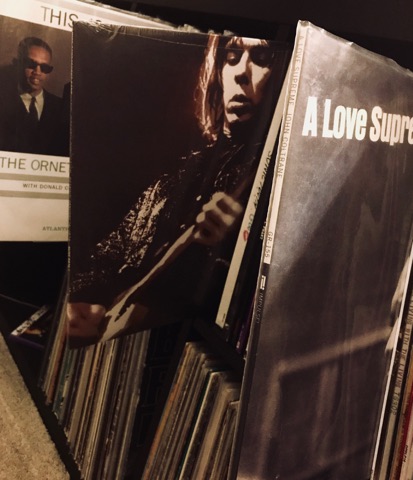
The Classic Quartet:  John Coltrane, McCoy Tyner, Jimmy Garrison, Elvin Jones. If you discuss Coltrane’s later work, which generally means releases after Ascension, you have to mention the works prior, especially A Love Supreme. While this album is more hard bop than avant-garde or free jazz, the freedom expressed in every note of A Love Supreme is only possible because of Coltrane’s trust in Tyner, Garrison, and Jones. The album’s opening notes are a call to prayer, then comes a pouring of honesty–a release like nothing I’d ever heard before or since. The members of the Classic Quartet were able to deliver Coltrane’s message of supreme love in deep moments of intensity and heavy pulses of enlightenment. Just like there’s no way to accurately describe the moments of truth in your life–those minutes of clarity when sense is delivered–it’s also damn near impossible to surmise this album with words. Ornette knew this when he freed himself of the constraints found in more traditional forms of jazz, and now Coltrane was touching the universe with his truth-seeking soulmates. By the way, the MC5 were formed the same year A Love Supreme was recorded. Detroit punk rock was born in the stardust.

Like Coltrane, finding a group you trust can help you develop and discover emotional honesty. Stop lying to yourself. It’s not the entire journey, but it’s certainly a first step.  Despite my love for The Classic Quartet, I’ve been absolutely floored by Coltrane’s later work, most of which was compiled and released by Alice Coltrane following John’s death. Coltrane ventured into the path of truth and brought with him some incredible musicians like Pharaoh Sanders and Rashied Ali.

My own journey to truth has been messy–there’s no denying that is fact. I continue to seek my classic quartet, to compose my own Ascension or Interstellar Space, but I may never find it. I’ve accepted that the journey is as important as the end result. Ornette Coleman layed down the marker for free jazz without the same notoriety or recognition as Coltrane, but it was the honesty of his expression that will forever be appreciated and honored. There is beauty to be found in your own dissonance–there are lessons to be learned. Find your path and try to make it true.

Depression in the Time of Socializing: My Story (abbreviated)

Solitude. It’s the great equalizer when you’re feeling marginally better about things. It gives you the opportunity to reflect, which often brings back the feelings you fight over and over again. You want to be alone, but your thoughts are the old friend who drops in to say hello, then criticizes you incessantly. Being alone isn’t always so lovely. You’re now emotionally overwhelmed. Words fail. You go back to sleep.

This was me before music.

Sam Cooke and Etta James. These two musicians were my musical baptism. My parents held me over the holy water and prayed, off-tune, but with passion. My primary education was in the school of Motown and Stax, I stumbled through courses in 80s pop and dance, then dabbled in all kinds of rock music. I was content. I was entertained.

In the early days of this period, when depression arrived, the thought of finding my voice within music wasn’t an option. I let myself be overwhelmed by everything an 80s suburban kid could gather–world famine, the threat of nuclear annihilation, being overweight, not wearing the right clothes, etc.  I rode my bicycle, but I didn’t have adventures that led me to stranded aliens or the local crazies. In the vastness of solitude and overthinking, I discovered emotional insecurity and started to withdraw. I was 12.

By the time I was in my late-teens, I had gone through periods of immense depression. I was the fat kid who was liked just enough to feel insecure about not being invited to a party. I was lost, and music was not helping. People around attended the high-profile concerts and they created tribes–think Christian Death vs. Metallica vs. Bell Biv Devoe. I was a mess of everything, which sounds great when you’re 35, but you need to carve out a place when you’re 16. My place was to internalize everything, feel unwanted, and say absolutely nothing. I stayed that way for several years, through the remainder of high school and into my 20s. I battled panic attacks, a near-death experience with weight loss, losing my virginity in the most vile way, and still feeling like the kid who never got invited to the parties.

“When you decide that your life is a prize…”

I gave up on trying to speak about it.  And by “it,” I mean everything. My depression managed itself in horribly unhealthy and destructive ways. I was 22 and somehow managed to find love, but I was poor at expressing my feelings of inadequacy and dependence upon others, so I fell back on self-deprecating jokes and my budding relationship with an eating disorder. However, I also heard something in music that had previously been foreign–a hint of clarity in my thinking. It started with simple lines about love, which also happened to be quite messy. Leonard Cohen sounded as fucked up as me, but his expressions of grief, failed love, sexual ugliness, distress, and failure were delivered in a way that made sense. I couldn’t fully wrap my head around what was happening, but I knew one thing:  I wasn’t alone.

It took me several more years to fully embrace the potential of music, which became all about me. I began to attend more shows, which by now had become scheduled exorcisms. I fell at the feet of these spiritual giants in the hope that my demons would be cast away. However, it didn’t work out exactly as planned because these guides were telling me the same thing:  Embrace those demons, understand they are a part of you, and learn to live, despite them. Carla Bozulich was my high priestess on this journey.  Her band, the Geraldine Fibbers, offered me a new way to dissect lyrics and find emotional connection within them. These songs were not just narratives about people I’d never meet, they were also stories about me. I learned how I felt about love (not so great) and life (much better). The exact reason for being alive still wasn’t clear, but I knew this new experience with music provided me with an additional layer of emotional complexity that I didn’t want to lose. I could let someone else say the things I couldn’t express myself. This was the breakthrough I’d always wanted, so I let the story consume me. I began to seek out other voices to help me make sense of my own conflicts. The world of battered souls, misplaced love, substance abuse, parental neglect, disconnect, intense passion, and survival was now mine. This is where I would find salvation!

With this blog, I hope to share stories that resonate intensely with some and entertain others. While my own journey may have resulted in self-discovery, there’s beauty to be found in the simple act of enjoying music. Finding yourself in song is something I wouldn’t recommend for everyone, nor would I suggest that depression can be managed with lyrics, but when an opportunity to make sense of your own complicated emotions reveals itself, don’t hesitate to grab hold and understand it. That’s you.