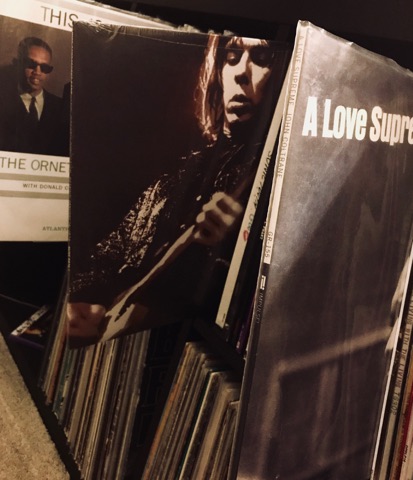
I’ve been lying to myself for a long time. For me, lying is often the easiest way to resolve an internal conflict, but the consequences are horrendous. Sure, for a short time, it frees me of the responsibility to face my problems. However, in the end, I feel like a coward and everyone around me suffers. That’s emotional dishonesty, and it’s the worst kind of lying for me.
When I discovered Ornette Coleman, jazz had only been a small talking point in my musical life–a cultural reference to understand the develop of music. From a listening perspective, I sought what was enjoyable and pleasant. Now, this was during the swing revival of the 90s, so bands like Squirrel Nut Zippers informed many of my choices. I’m half kidding, but you get the point. What initially brought me to Ornette was an essay that would change my life forever: Lester Bangs’ Free Jazz/Punk Rock, which I always refer to as Free Jazz is Punk Rock in conversation. I know it’s not correct, but it sounds way more aggressive. It’s an essay I’ll come back to another time because it deserves a more focused discussion. However, for now, it can be viewed as the motivation for me to explore. The main point of Bangs’ essay is to relate the bravery found in free jazz to New York’s No Wave bands. The purity and intensity found in both deliver an almost spiritual path to emotional honesty.
Backing up just a bit, there’s a back story in the development of jazz that sometimes gets overlooked from a cultural perspective–jazz as entertainment. Which it was…for a very long time. For a moment, Dizzy Gillespie was utilized by the U.S. State Department to advance democracy around the world and to counter communist propaganda. It was thought that using a successful black man to promote American values was proof of a superior society. However, at the same time, the birth of the Civil Rights movement was approaching and black citizens were being denied basic human rights. Ornette Coleman rejected the presentation of jazz as purely entertainment. Within the very musical compositions, a world of emotion could be expressed. While certainly nothing new in music, the explosive presentation and emotional release of free jazz would be revolutionary. Free Jazz is Punk Rock.
The Classic Quartet: John Coltrane, McCoy Tyner, Jimmy Garrison, Elvin Jones. If you discuss Coltrane’s later work, which generally means releases after Ascension, you have to mention the works prior, especially A Love Supreme. While this album is more hard bop than avant-garde or free jazz, the freedom expressed in every note of A Love Supreme is only possible because of Coltrane’s trust in Tyner, Garrison, and Jones. The album’s opening notes are a call to prayer, then comes a pouring of honesty–a release like nothing I’d ever heard before or since. The members of the Classic Quartet were able to deliver Coltrane’s message of supreme love in deep moments of intensity and heavy pulses of enlightenment. Just like there’s no way to accurately describe the moments of truth in your life–those minutes of clarity when sense is delivered–it’s also damn near impossible to surmise this album with words. Ornette knew this when he freed himself of the constraints found in more traditional forms of jazz, and now Coltrane was touching the universe with his truth-seeking soulmates. By the way, the MC5 were formed the same year A Love Supreme was recorded. Detroit punk rock was born in the stardust.
Like Coltrane, finding a group you trust can help you develop and discover emotional honesty. Stop lying to yourself. It’s not the entire journey, but it’s certainly a first step. Despite my love for The Classic Quartet, I’ve been absolutely floored by Coltrane’s later work, most of which was compiled and released by Alice Coltrane following John’s death. Coltrane ventured into the path of truth and brought with him some incredible musicians like Pharaoh Sanders and Rashied Ali.
My own journey to truth has been messy–there’s no denying that is fact. I continue to seek my classic quartet, to compose my own Ascension or Interstellar Space, but I may never find it. I’ve accepted that the journey is as important as the end result. Ornette Coleman layed down the marker for free jazz without the same notoriety or recognition as Coltrane, but it was the honesty of his expression that will forever be appreciated and honored. There is beauty to be found in your own dissonance–there are lessons to be learned. Find your path and try to make it true.
 theinfluenceofheat.com
I love the way your words conjure so much imagery. You are a writer’s writer and I don’t say that often. There is only one other person who I’ve ever told that and that is my friend and fellow writer, Amanda Magee. You invoke a connection to your story with your turn of phrase.Keep writing. I know music is where you find solace but your words give solace to others. The honesty in your writing is what makes you so relatable.
LikeLike